SITUATION
A medium-sized API plant was tasked by the wider organisation to improve performance and efficiency through three specific goals:
- Reduce the cost of manufacturing
- Increase output
- Address FDA warnings due to graphite disc usage
ACTION
The plant asked OsecoElfab to inventory all the bursting discs used, with a view to identifying cost-saving opportunities. A plant survey found 137 different disc tags in use, comprising graphite, composite and metal discs. There were over 100 variants for these tags, each with different burst pressures or temperatures, and sizes ranging from 25mm to 150mm. This wide variety of tags and variants was not only complex to manage, but meant there was a higher risk of disc fatigue, premature failure and spurious alarms, as well as the risk of contamination. These issues generated a high annual cost for replacing rupture discs.
STOCK RATIONALIZATION: THREE PROPOSED SOLUTIONS
Option 1 - Do nothing: Costs remain at the same high level (plus potentialadditional costs and risk of downtime due to therisks identified above).
- Higher risk of unscheduled stoppages
- Higher risk of product waste
- High disc usage
- Requires high preventative maintenance
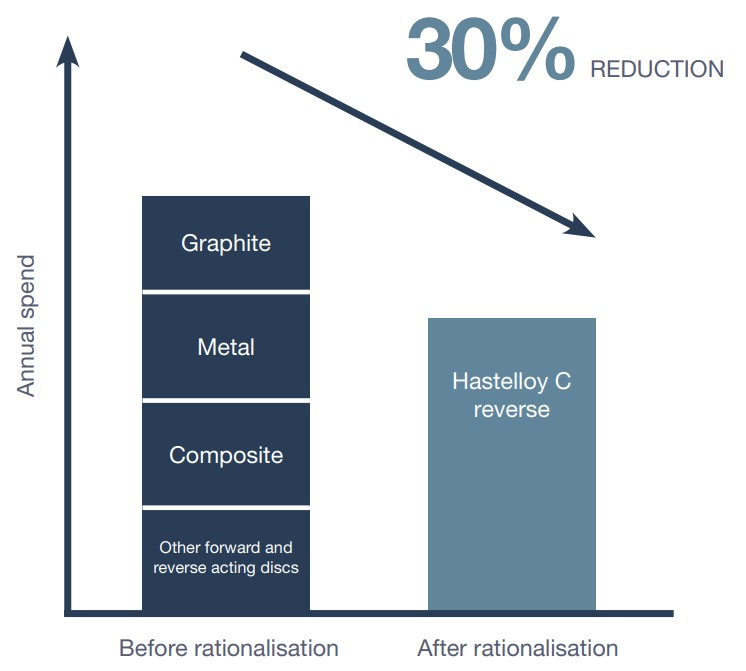
Option 2 - Implement disc rationalisation only: Costs reduce by 10% over three years including costsfor new holders. After year 3, all the holders have been purchased, and the cost reduces by a further 20% per annum.
- Reduces risk of process interruption due tofatigue or corrosion
- Reduces risk of contamination
- 30% less annual spend overall on rupture discs after year 3
Option 3 - Implement disc rationalisation and extend maintenance period to three years by using Pure-Gard: 3-year costs immediately reduced by 27% including costs for new holders. After year 3, this reduces by a another 30% for significantly lower annual costs.
- All of the above benefits PLUS:
- Reduction in maintenance man hours
- Opportunity for increased uptime
- Reduced disc usage
- 57% less annual spend overall on rupture discs after year 3
CHOSEN SOLUTION: OPTION 2
The customer opted to rationalize their stock of bursting discs by using the reverse acting Opti-Gard disc in Hastelloy C throughout the plant. This enabled them to reduce the disc variants from 100 to 62, with complete removal of graphite discs. After an initial investment in the holders required for the reverse acting discs, the annual spend on replacing rupture discs decreased by 30% as predicted.